- Home
- >
- Activities
- >
- The Gallery of the New university – Faculty of Slovenian and International Studies
- >
- Exhibitions
- >
- Exhibition of paintings by Barbara Demšar: Bring me flowers
Exhibition of paintings by Barbara Demšar: Bring me flowers
Barbara Demšar is a painter who originates from the picturesque surroundings of Škofja Loka, from an idyllic landscape that many visual artists have explored and sought to interpret as authentically as possible. Yet landscape is not merely a place of inspiration, but also a place of retreat — a space that opens the door to an individual’s inner, spiritual world. It leaves traces within, traces that become an intimate reflection of the external world, a mirror upon the surface of the soul.
Barbara is one of those painters who cultivate such an introverted perspective. She has internalized her living environment, allowing her most personal emotions to take deep root within it, and permitting her most beautiful memories to call her gently toward the painter’s canvas like a soft breeze. On the pictorial plane, new interpretative pathways open before her — those that, in terms of both content and formal solutions, are subjective, deeply intimate, and represent a process of self-reflection. The peace of the natural environment becomes her inner peace; the energy and light of nature become the painter’s personal strength and positive outlook; the colors of the external world transform into an inner atmosphere, most often warm and radiant, yet at times cooler and entirely contemplative. Turning inward allows her to make an artistic shift, to create a new visual evaluation — a personal, imaginary landscape, a unique garden, and her own private time spent within it. It is a visually rich and authorially recognizable world populated by motifs of blooming gardens and meadows. The artist “waters” this motif with a multilayered experience of space and everything that forms an irreplaceable part of her personal and artistic identity.
The transition into the inner landscape takes the form of an open, seemingly infinite space. In the past, the artist based her compositions on the fundamental realities of the natural environment, often clearly defining them in horizontal bands. Today, however, we rarely perceive a line that delineates the surface. Her flowers grow and bloom without grounding, within an atmosphere that is more spiritual than real. With soft and organic brushstrokes, she creates flower stems and individual blades of grass that establish compositionally important and symbolically charged verticals. The pictorial field is unified and expansive, without limitations, extending even beyond the edges of the canvas itself. When the viewer approaches it, it seems as though their body enters the body of the painting — into the painter’s unique and deeply personal garden.
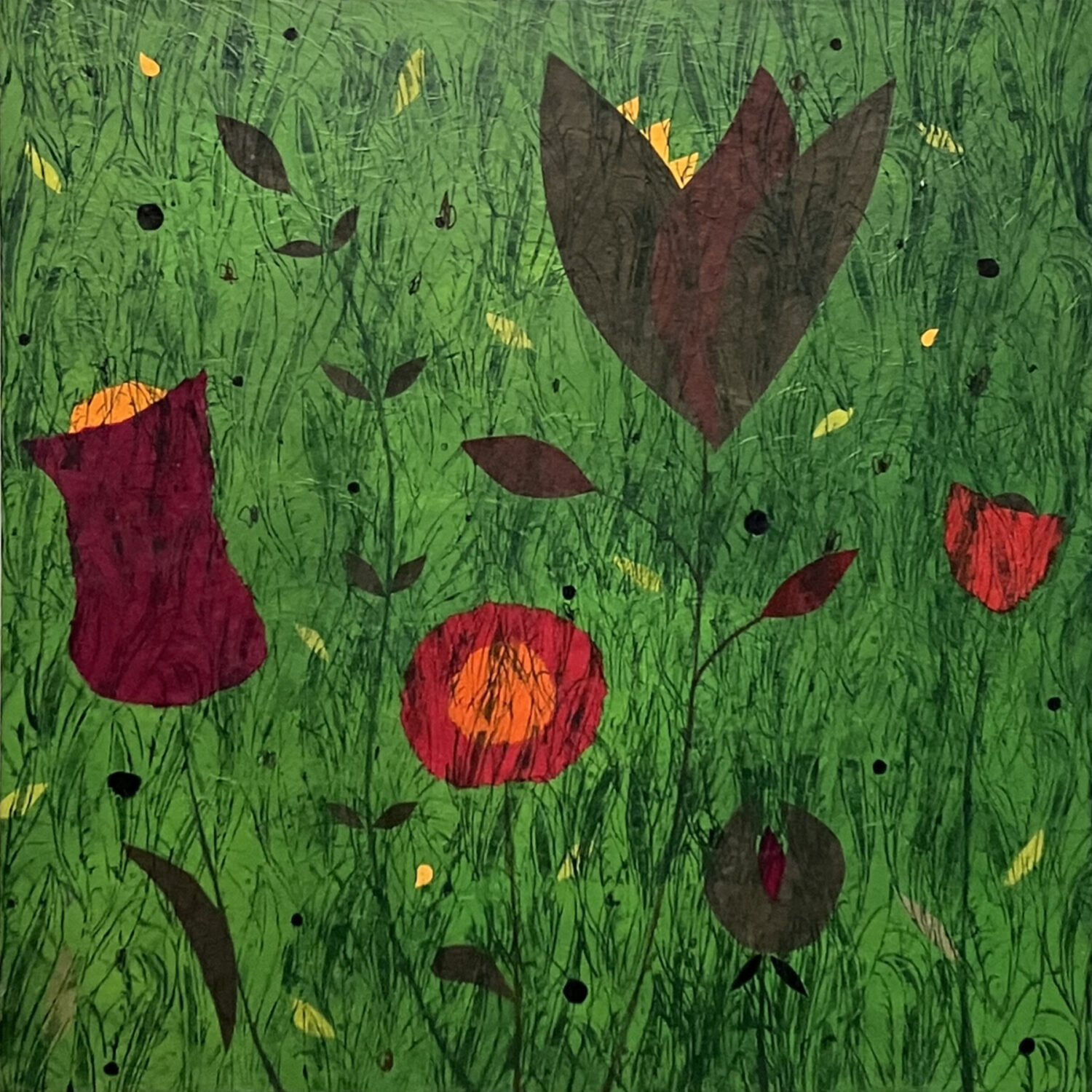
In the works from the series My Gardens and It Is a Beautiful Day, the painter places flowers — her principal protagonists — against more or less homogeneous color backgrounds, as well as surfaces of barely perceptible textural patterns. She gives the flowers distinctly stylized forms, although many could still be botanically identified (tulips, umbellifers, and others). She does not merely place them onto the canvas in a traditional painterly manner, but employs the principle of collage. Their blossoms are shaped from papers of different types, colors, and textures, which are then attached to the pictorial surface. This evokes associations with the making of a herbarium, while simultaneously confirming the great importance of collage technique within her practice — a means through which she realizes her own conceptual and design strategy, always guided by painterly thinking. She creates the appliqués by tearing the material, preserving organicity and producing a “natural” edge. The stylized flowers unfold in playful formal variations, positioned on slender stems with a few leaves. In incorporating collage, she preserves the airiness of the space and adheres to refined visual-aesthetic norms that manifest themselves within balanced internal relationships.
Individual segments are further articulated through the use of various threads, which establish the presence of a special kind of drawing. The thread assumes the role of line, yet true classical contours — graphic marks as well as lines created by individual traces of color — also maintain their place and function. Through drawing, she creates a parallel between the originality of nature and her own originality, achieving an immediate sense of lived expression. Her drawing is continuous, fluid, active, and form-generating; at times it becomes a fleeting linear impression, a momentary point of pause — in short, a kind of movement within the atmosphere that might be attributed to the dynamics of air currents.
Alongside the floral motifs, various fragments also appear within the pictorial field: butterflies, birds, plant leaves, as well as small elements not always directly linked to nature, but functioning instead as symbolic condensations — signs of emotional, sensual, and intellectual impressions that lend the whole composition a sense of visual vitalism.
Alongside these simple yet playful forms, color also reveals itself throughout one’s journey into the painter’s world. It creates an atmosphere rich with layered meanings. Warm and sunlit values predominate — yellow, orange, and red — alongside increasing amounts of spring green, as well as sandy, warm gray, and entirely pastel tones that evoke serenity and meditation. Against these backgrounds, the flowers once again introduce vibrant chromatic energy.
The surfaces of the paintings are never monotonous, for layering and structural accents play an important role within them. Since nature is the greatest master of textures, the artist approaches it in this way and pays homage to its inherent qualities. She creates the specific texture of the surface through various methods, achieving vibrancy even through the imaginative application of paint with wall rollers. In doing so, she establishes a rhythmic surface pulse and simultaneously a repeating pattern of aesthetic perfection possessing strong optical values akin to a secondary pattern or moiré effect.
The fact that the painter’s colors are often radiant and illuminated reveals her fascination with light. Light is laterally present within the painting, without a clearly defined source. External light, moving across the texturally dynamic surfaces of her works, creates barely perceptible shadows and becomes a magical co-creator of visual richness.
Barbara Demšar brings us flowers, yet these are not merely visual-aesthetic elements, but a means of narrating the inner world of the human being. Her flowers rise upward and represent spiritual growth, humanity’s striving from the material toward the spiritual sphere; above all, the works reflect the artist’s personal feelings of tenderness, solitude, memory, and quiet hope. In this way, Barbara transcends conventional floral themes and enters the realms of self-revelation and broader poetic meditation on nature and the relationship between humanity and the natural world.
Her entire oeuvre functions as a subtle and sublime dialogue between the outer and inner worlds, between the garden as a real space and the garden as a metaphor for human intimacy.
Anamarija Stibilj Šajn
About the author
Barbara Demšar graduated in Art Education from the Faculty of Education in Ljubljana under Professor Herman Gvardjančič (1997). She is a member of the Association of Slovenian Fine Arts Societies (ZDSLU) and the Škofja Loka Artists Association.
She has held more than 30 solo exhibitions and participated in over 300 group exhibitions in Slovenia and abroad. For her work, she has received 28 awards in Slovenia, Croatia, and the United States. Among the most notable are the artistic grant from the Adolph and Esther Gottlieb Foundation and the artistic grant from the Pollock-Krasner Foundation.
She lives and works as an independent artist in Škofja Loka.